Oregon Art Beat
Vitality of the Human Spirit
Season 24 Episode 4 | 28m 43sVideo has Closed Captions
James Lee Hansen, Hālau Hula O Nā Pua O Hawai'i Nei, Symbiosis
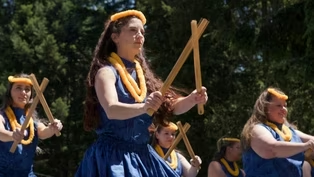
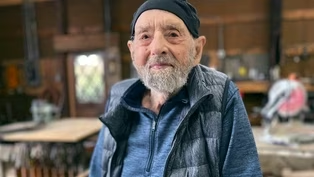
James Lee Hansen is one of the Northwest’s most prominent and influential sculptors. Today, at age 97, Hansen is proud of the nearly 600 sculptures he’s created; Hālau Hula O Nā Pua O Hawai' is a hula halau based out of Eugene Oregon. Their kumu (teacher) is committed to creating a space that teaches Hawaiian culture through hula; Symbiosis immerses audiences in four dimensional storytelling.
Problems playing video? | Closed Captioning Feedback
Problems playing video? | Closed Captioning Feedback
Oregon Art Beat is a local public television program presented by OPB
Oregon Art Beat
Vitality of the Human Spirit
Season 24 Episode 4 | 28m 43sVideo has Closed Captions
James Lee Hansen is one of the Northwest’s most prominent and influential sculptors. Today, at age 97, Hansen is proud of the nearly 600 sculptures he’s created; Hālau Hula O Nā Pua O Hawai' is a hula halau based out of Eugene Oregon. Their kumu (teacher) is committed to creating a space that teaches Hawaiian culture through hula; Symbiosis immerses audiences in four dimensional storytelling.
Problems playing video? | Closed Captioning Feedback
How to Watch Oregon Art Beat
Oregon Art Beat is available to stream on pbs.org and the free PBS App, available on iPhone, Apple TV, Android TV, Android smartphones, Amazon Fire TV, Amazon Fire Tablet, Roku, Samsung Smart TV, and Vizio.
Providing Support for PBS.org
Learn Moreabout PBS online sponsorshipSupport for Oregon Art Beat is provided by... and OPB members and viewers like you.
[ ♪♪♪ ] MAN: I've just lived this little while, going on 97 years now, and I have a lot of work that could last for thousands of years.
WOMAN: Hula carries the legend and the history, all the things that our ancestors passed down to us.
We need to take those down to the next generations.
WOMAN: It really is about what does it mean to be human, what does it mean to be alive, and what does it mean to be kind of part of the larger ecosystem and changing world?
[ ♪♪♪ ] I've wondered about why I chose to be a sculptor, and I got to thinking about it that I'm probably more primitive than painters.
Because all I have to do is reach down and get the earthdust of stars and start making something.
I don't have to have canvas or vellum or paper or paint and frames.
I just have to have the earth.
A little bit like God, I suppose.
[ laughs ] Oh, goodness, heh, we're going back.
[ ♪♪♪ ] Here I am all dressed up.
I was born in 1925, and the Depression didn't hit till '29.
And then our life really changed.
James Lee Hansen is a native Northwesterner.
He was born in Tacoma, and, oh, I think it was age 6, moved to Vancouver, Washington.
James graduated from high school, and it was the war.
And, of course, I wanted to go in the Marines, so I went in there, and it was about noon, and they'd stepped out for lunch.
And so I didn't want to wait, so I went to the next recruiting place, which was the Navy, and I enlisted in the Navy.
Thank God.
I'd be dead if I was in the Marines.
BRUCE: As a sailor in the Pacific, Hansen saw battle and its grisly results.
It was a life-shaping experience.
[ ♪♪♪ ] He came back to the Northwest, and the G.I.
Bill let him go to the Museum Art School at the Portland Art Museum.
JAMES: So many of my friends were such good painters.
I didn't see my work being that good, and I just found myself leaving other classes and going into the sculpture room and start making some sculptures.
BRUCE: Jim had no art history, so he developed his aesthetic not by copying Rodin or modeling after the plaster casts of Roman sculpture in the museum's collection.
What he had to search out was a vocabulary that was in the present.
JAMES: One of the Portland painters at Museum Art School said that I had "dumb originality."
I haven't seen enough art to have something that I was going to emulate.
So I had-- perhaps that was true-- dumb originality.
[ laughs ] [ ♪♪♪ ] BRUCE: In 1952, he entered the San Francisco Art Association's annual, which was a national thing, and Jim won the first Purchase Award prize in sculpture.
And it was a surprise, because he was just out of school.
But his vision was unique.
All of a sudden, I'm a rock star of some ilk, so things started happening after that.
Very early in his career, he established his own foundry in his studio.
JAMES: And so I made my own kilns, made my own furnace.
It just got bigger and bigger and bigger and bigger.
First thing you knew, I had to build scaffolding to get up high enough to pour the molds.
Jim started a collective group of artists called Builders Arts, and what it was was a group of his pals and people who'd been through art school with him, like Lee Kelly and Izquierdo and Byron Gardner and people like that.
Here's Don and his mosaic mural.
It was terrific.
[ ♪♪♪ ] What I loved about Builders Arts was that everyone had a job.
It wasn't the money, really, but it was nice to finally get some work that we could, you know, buy groceries.
I like the way they're getting patinas.
I haven't seen them for a while, and the patina on this one and that one back over there is quite... coming along.
All these-- all this patina is just right on.
[ ♪♪♪ ] People think I do it, but it's... it's time that's doing it.
And, uh, I started it, but time's finishing it.
BRUCE: World War II had an impact on James Lee Hansen's work.
It is in the soul of the work, a growing sense of sobriety and hopefulness.
I want to express the vitality of the human spirit.
And who can explain that succinctly?
[ chuckles ] It is...
It is a small wonder.
It's just a small wonder.
This is my favorite side, but other people like the other side better.
And, uh... And I can see why.
I like it-- I like it through here.
BRUCE: Well, you know, I'm always surprised when I walk around one of Jim's sculptures, because I think I get it, you know?
You look at one side and you think you understand it, and you begin to walk around and suddenly you discover, "Oh, there's another leg.
Where did the armor go?
It's open.
It's vulnerable."
And he's built in both strength and fragility.
A particularly good-- good shot is right... right here.
[ chuckles ] So... it holds up... from any view.
[ ♪♪♪ ] James Lee Hansen has remained a singular voice aesthetically in the Northwest.
He is one of the most inventive and productive sculptors we've seen.
I've just lived this little while, uh... You know, going on 97 years now.
And I have a lot of work that could last for thousands of years.
I'm proud of almost all of it.
So it's a... a legacy.
And I think, uh...
I think everybody wants to have a legacy.
Everybody.
[ women singing in Hawaiian language ] Ready, and one and two, push back, two, three.
Hela left and right.
Kawelu left, two, three.
My name is Akiko Colton.
I am kumu hula of this Hulau Hula o Na Pua o Hawai'i Nei.
One, two, three.
Turning kaholo left.
[ ♪♪♪ ] STEVEN TONTHAT: Akiko Colton came to Hawaii from Japan for college.
While working at the Polynesian Cultural Center, she fell in love with the artistry of hula and the native Hawaiian culture.
She then made her way to Eugene, Oregon, where she continues the long, beautiful, and sometimes challenging history of the art of hula as kumu, or teacher.
[ speaks in Hawaiian ] [ hula music plays over stereo ] To your heart, pull.
First I fell in love with the music and the motions, the hand motions.
And as I study more, I like the stories actually behind the songs and all the hard work we have to put to create something good together with the hula sisters and hula ohana.
Halau Hula O Na Pua O Hawai'i Nei means "hula school of flowers of Hawaii."
So we consider each of us a flower from Hawaii and hopefully all learn to be beautiful as we learn how to hula.
Ready, shake!
[ rattles rattling, music plays on stereo ] Good!
Any new dancers coming to Halau, their image is, "Hula is this."
[ ♪♪♪ ] So I make sure they pull elbow out, make sure their arm go to the right place, and I think that's a really big change from their mind image of hula to actual hula.
[ ♪♪♪ ] Hula was a celebrated art form in ancient Hawaii.
Then, in 1830, Queen Ka'ahumanu, who had converted to Christianity, banned the cultural performance.
However, in 1886, King David Kalakaua brought hula back, saying that hula is the language of the heart, and therefore the heartbeat of the Hawaiian people.
And now we celebrate his effort to bring hula in April for the Merrie Monarch Festival.
ANNOUNCER: From He'eia, Kane'ohe, O'ahu under the direction of Kumu Hula Aloha Dalire.
AKIKO: Hula carries the legend and the history of all the things that our ancestors passed down to us.
We need to take those down to the next generations.
[ speaks in Hawaiian ] The Hula Kahiko is an ancient hula.
We use ipu heke, or hula pahu, the pahu drum, for the beat.
[ women chanting ] It's a chant.
Usually the chant is for our king and queen, chief, gods, or historic places.
And costumes not too fancy.
Make sure the costume match with the era the chant came from.
[ drumming stops, crowd applauding ] Hula 'Auana, on the other hand, is a modern hula.
You hear ukulele, guitar, piano.
[ music playing over speakers ] And the costumes become a variety of colors and fabrics.
I start with 'Auana.
Especially beginner level class, I start with 'Auana.
I think it's easier to love hula...
Awesome!
...from 'Auana because of the music and the somewhat easier motion.
Give me the palm tree.
Gentle sway.
Nice!
Here we go back to kahalo, ready, and step together, step, step... WOMAN: My connection to Hawaii is I was born and raised there.
So my husband's Hawaiian line goes way, way back.
So just keeping that within the family and them knowing their culture and they have a piece of it, at least.
-AKIKO: One ami.
-CHILDREN: One ami.
[ Akiko and children speak in Hawaiian ] Okay, kaholo, one level.
AKIKO: Upper level, I try to do at least one Kahiko a year so they can learn history or story of those legendary beings.
[ speaking in Hawaiian ] ...regular, one level.
One level.
Whoo!
So at the Halau, when we practice, storytelling is really important to make sure the motion go to the right place, because it's easy to change the story with just one hand motion.
Kaholo right, going back and bring your hands in... Do this way first.
Bring to me, then palms down.
GIRL: Yeah, I think she's really good about explaining things.
And she has a lot of patience to make sure that everyone is at the same-- Like, they all understand it.
And then she'll move on to the next verse.
And... And left foot and left, right, left, right.
Drop!
And left.
Left foot.
GIRL: I like the duck, walk, roll, even though sometimes it gives me carpet burn on my elbows, but it's fun.
It sometimes hurts after a while, but it's just... it's also hilarious to watch your teammates do it.
AKIKO: This is our annual Ho'ike, or show, we do every June after school gets out, and we put almost all the songs we learn in the year.
[ music plays over speakers ] [ rattles rattling, all chant ] And this year had 48 dancers on the stage.
I used to have close to a hundred before COVID.
It was a very nice turnout.
[ music playing ] Hula tells stories, and of course music and chant are with those, too.
Together we can keep the Hawaiian culture and history alive.
And now it's part of my life, so I cannot just take out.
My blood needs hula.
ALL: Aloha!
[ crowd cheering, applauding ] [ ♪♪♪ ] [ ♪♪♪ ] WOMAN: A lot of folks love to control things, right?
What this project does that really moves me deeply is it takes that control piece out.
MAN: Within "Symbiosis," people have to really let go of their human body position, their body architecture.
And it opens up new space for new perspectives.
ERIC SLADE: "Symbiosis" is an extended reality experience created by the Dutch design collective Polymorf.
It includes not just sight and sound but also touch, smell, and taste.
It leads guests on an immersive journey 200 years in the future where they must adapt to a collapsing ecosystem.
"Symbiosis" had its U.S. premiere in November of 2022 at the Portland Art Museum's Center for an Untold Tomorrow.
The Center for an Untold Tomorrow is here is here to change for whom, by whom, and how cinematic stories are told.
We are carving out a niche here in Portland for artists and for audiences who are not content to be contained.
Welcome to "Symbiosis" by Polymorf.
When guests first arrive at "Symbiosis," they decide which creature they'd like to inhabit.
This is Camilla, so it is a cross between an orchid flower, a monarch butterfly, and a human.
[ ♪♪♪ ] Then staff members help them climb into suits specially designed to help them experience what it's like to live as a human/butterfly hybrid, a slime mold, or four other creatures.
AMY: It's got a little bit of Blade Runner and a little bit of something organic about it as well, and so I think that that push/pull between this technology piece and still seeing something that is organic and feels like a life form really makes the experience come alive.
[ ♪♪♪ ] [ birds chirping, creatures chittering ] WOMAN [ in game ]: Where does that sound come from?
[ creature calling in distance ] Once inside, visitors embark on one of six different journeys.
In all of the stories, the human visitor has symbiotically merged with another life form.
WOMAN [ in game ]: When I turned 16, as a coming-of-age gift, I got my first real insect implants.
The story is based on Staying with the Trouble, a 2016 book by Donna Haraway.
[ barks ] Haraway believes that the only way out of the predicaments we've created on Earth is for humans to work together with other creatures.
MAN: We need to move to a more humble position in which we are really respecting and acknowledging that we are part of this ecosystem living on Earth.
MAN: It's about sharing control and becoming with the otherness and the other critters, other things, and that means redistributing control and power.
And that can be fun, too, you know?
It's interesting, because then...
It feels like you have to lose something, but maybe you gain something.
Yeah.
As the story progresses, baffles in the suit inflate and deflate, pulling guests deeper into the experience.
Custom scents are released, synchronized with moments in the story.
And at several points, visitors are prompted to taste food specially created for the journey.
WOMAN [ in game ]: Looks tasty.
Let's try to eat it.
AMY: I think with any storytelling, there's technology.
And to me, this technology really enhances what it's like to be alive as these creatures.
[ water bubbling ] MARCEL: By playing around in this virtual reality of what might be, you also train yourself for future scenarios, and I think that's really the biggest importance of being a storyteller, is that you offer that to humanity, to each other.
If you make powerful stories, you actually have power to change stuff.
[ air hissing ] As the story ends, visitors are returned back to everyday reality... Whoo, hello.
All right, you're free.
...and have a chance to connect and compare experiences.
Um, surreal.
There was a lot of conflicting feelings for the... for the toad.
It said "open your mouth," so I did.
[ both laugh ] Everybody's had their own story, but we have found how amazing it is that people come together that don't know each other, trying to figure out how they're interconnected, what each other's experience was.
You were wandering around a pond.
I want to live there.
[ chuckles ] AMY: The thing that's really special about this is for all of the fanciness and the technologies that are being used to tell this story, it is a simple fairy tale.
It really is about what does it mean to be human, what does it mean to be alive, and what does it mean to be kind of part of the larger ecosystem and changing world?
[ ♪♪♪ ] [ hula music playing over speakers ] To see more stories about Oregon artists, visit our website... And for a look at the stories we're working on right now, follow us on Facebook and Instagram.
Support for Oregon Art Beat is provided by... and OPB members and viewers like you.
Hālau Hula O Nā Pua O Hawai'i Nei
Video has Closed Captions
Clip: S24 Ep4 | 8m 55s | Hālau Hula O Nā Pua O Hawai'i Nei is a hula halau based out of Eugene Oregon. (8m 55s)

Video has Closed Captions
Clip: S24 Ep4 | 6m 11s | Symbiosis immerses audiences in a four dimensional storytelling experience. (6m 11s)
Video has Closed Captions
Clip: S24 Ep4 | 10m 54s | James Lee Hansen is one of the Northwest’s most prominent and influential sculptors. (10m 54s)
Providing Support for PBS.org
Learn Moreabout PBS online sponsorship









Support for PBS provided by:
Oregon Art Beat is a local public television program presented by OPB